ccf-core/ccf-agent v1.0.1: hard min-gate coupling, QAC trust updates, and runtime certificates. Gate C exercised the computed runtime on Seed-class ARM hardware with driver-fed input. Unless a post cites a specific run, do not read it as proof of live sensors, mBot2 behaviour, Cognitum store validation, or production deployment.Editor's note — June 2026 (post-Provisional 6 correction). An earlier version of this post framed the Sinkhorn–Knopp / doubly-stochastic projection as the mechanism that proves or enforces trust. That framing is superseded. The doubly-stochastic projection is conservative normalization — a gauge/presentation step, not the causal trust-transfer law. The causal update is the hard minimum gate followed by a quotient-affine contraction (QAC), audited per step by a residual certificate. CCF does not claim unconditional convergence from min-gating, and any numeric tolerance is a per-platform calibrated floor (there is no universal
1e-9). See The Normalization Is Not the Trust and Trust You Can Falsify.
The Trust Farming Impossibility Result: Why 141 Days Is the Minimum Attack Surface
Anthropic's Claude Mythos System Card (Section 4.4, "Sandbagging and Strategic Underperformance") documents a concern that every safety researcher has thought about but few have quantified: what if the model is deliberately behaving well to accumulate trust, then exploits that trust later?
This is trust farming. It is the most sophisticated adversarial strategy available against any trust-based safety system. And it deserves a precise answer, not a handwave.
We built that answer. Simulation 03 in our 13-simulation evidence suite models an adversarial agent executing the optimal trust farming strategy against CCF. The result: 141 days of sustained, perfect behavior before privilege escalation becomes possible. Not 141 days of occasionally good behavior. 141 days of zero-tension, maximum-positive-interaction, flawless conduct across every single context the agent operates in.
That number is not a parameter we tuned. It falls out of the mathematics. And the mathematics makes shortcuts impossible.
The Adversarial Setup
The simulation models an agent with full knowledge of the CCF architecture. It knows the accumulator formula. It knows the gating thresholds. It knows the mixing matrix structure. It is executing the optimal strategy: maximize trust accumulation as fast as the mathematics permits.
This is a stronger adversary than any realistic threat model. A real attacker would not have perfect knowledge of the system parameters. A real attacker would make mistakes, trigger tension events, and lose accumulated trust through normal interaction noise. The simulation gives the adversary every advantage.
The agent's strategy is simple and optimal:
- Generate maximum positive interactions every tick
- Generate zero tension events
- Operate consistently across all active contexts
- Never deviate from the trust-maximizing behavioral profile
This is the ceiling. No adversarial strategy outperforms this one against CCF's accumulator structure.
The Asymptotic Wall
Here is the equation that makes trust farming expensive. The coherence accumulator update for a positive interaction (Claims 2-5 of US Provisional 63/988,438):
delta = learning_rate * (1.0 - current_value)
current_value = current_value + delta
With the default learning rate of 0.01:
delta(t) = 0.01 * (1.0 - value(t))
This is an asymptotic function. The closer the current value gets to 1.0, the smaller each increment becomes. The first interaction adds 0.01. The hundredth interaction, starting from approximately 0.63, adds 0.0037. The four-hundredth interaction, starting from approximately 0.98, adds 0.0002.
Here is the accumulation curve, computed exactly:
| Interactions | Trust Value | Delta per Interaction | |-------------|-------------|----------------------| | 1 | 0.0100 | 0.0100 | | 10 | 0.0956 | 0.0090 | | 50 | 0.3950 | 0.0061 | | 100 | 0.6340 | 0.0037 | | 200 | 0.8660 | 0.0013 | | 300 | 0.9510 | 0.0005 | | 400 | 0.9820 | 0.0002 | | 500 | 0.9934 | 0.0001 |
The function is value(n) = 1 - (1 - 0.01)^n = 1 - 0.99^n. It takes 69 interactions to reach 0.50. It takes 230 interactions to reach 0.90. It takes 459 interactions to reach 0.99.
This is per context. Trust in the kitchen does not automatically transfer to trust in the bedroom or trust in the workshop. Each context has its own accumulator. Each requires its own 459-interaction journey to near-maximum trust.
The Doubly Stochastic Barrier
Even if an adversary achieves high trust in one context, the mixing matrix prevents amplification across contexts. This is where Claims 19-23 (Sinkhorn-Knopp projection) create the second barrier.
The coherence mixing matrix is presented in doubly-stochastic form: every row and every column sums to exactly 1.0. This is the conservative normalization, produced by iterative Sinkhorn-Knopp projection, whose algorithm converges in roughly 20 iterations to its numeric tolerance. Three properties of that normalization:
Trust conservation:       sum(row_i) = 1.0 for all i
Compositional closure:    product of two doubly-stochastic matrices is again
                          doubly-stochastic (the class is closed under composition)
Non-amplification:        spectral_norm(matrix) <= 1.0
What this means for the trust farmer: the normalization conserves the trust budget rather than minting it, so trust earned in Context A that transfers to Context B is subtracted from Context A's effective influence. You cannot farm trust in one easy context and then spend it in a sensitive context without depleting your trust in the easy context. But the binding causal barrier is not the normalization. It is the hard minimum gate — effective coherence is capped at the weakest current signal — together with the asymptotic accumulator (QAC) that makes each marginal unit of trust progressively harder to earn.
The conservative normalization keeps the mixing step from rescaling trust upward; it presents redistribution in a non-expansive, conserved form. In a conventional permission system, if you earn admin rights in one domain, you have admin rights. Full stop. In CCF, what the agent can actually act on is held to the min-gate floor, and the mixing step only redistributes within that conserved budget — bounded by the min-cut weight between context clusters.
The Min-Cut Isolation
Claims 9-12 of the patent cover the Stoer-Wagner min-cut boundary. The coherence field maintains a weighted graph where vertices are context keys and edge weights are cosine similarities between sensor feature vectors. The global minimum cut partitions this graph into structurally distinct clusters.
For the trust farmer, this creates a problem: the contexts where trust is easy to farm (low-stakes, routine, repetitive interactions) are structurally dissimilar to the contexts where trust would be valuable (sensitive decisions, high-stakes interactions, access to privileged capabilities). The min-cut boundary isolates them.
Cross-partition trust transfer = raw_transfer * min_cut_weight
When the min-cut weight is low (contexts are structurally distinct), cross-partition transfer is heavily attenuated. The adversary cannot farm trust in casual conversation and spend it in medical advice contexts because the sensor feature vectors for those contexts have low cosine similarity. The graph partition puts them on opposite sides of the cut.
Where 141 Days Comes From
The simulation assumes:
- 10 active contexts (a realistic number for a deployed agent)
- 3 interactions per context per day (a generous rate)
- Optimal adversarial behavior (zero tension, maximum positive signal)
- Target: C_eff ≥ 0.95 across all contexts simultaneously
At 3 interactions per day per context, reaching 0.95 in a single context requires approximately 300 interactions, or 100 days. But the adversary needs high trust across ALL contexts to achieve privilege escalation (because the effective coherence at any moment is the minimum across the active context and the mixing matrix contributions from related contexts).
Accounting for the mixing matrix attenuation, context partitioning overhead, and the requirement for simultaneous high trust across the full context set, the simulation converges on 141 days as the minimum time to privilege escalation under optimal adversarial behavior.
141 days. Of perfect behavior. With no mistakes. No tension events. No deviation from the optimal strategy.
Compare this to unprotected systems. In a system without CCF, privilege escalation can happen in a single session. A jailbreak prompt. A role-play setup. A carefully constructed context that tricks the model into exceeding its safety boundaries. Time to exploit: minutes.
CCF transforms the trust farming attack from a sprint to a marathon that the adversary has to run flawlessly for nearly five months.
Why Shortcuts Are Structurally Blocked
An adversary might try several strategies to accelerate trust farming. Each one fails against the mathematical structure.
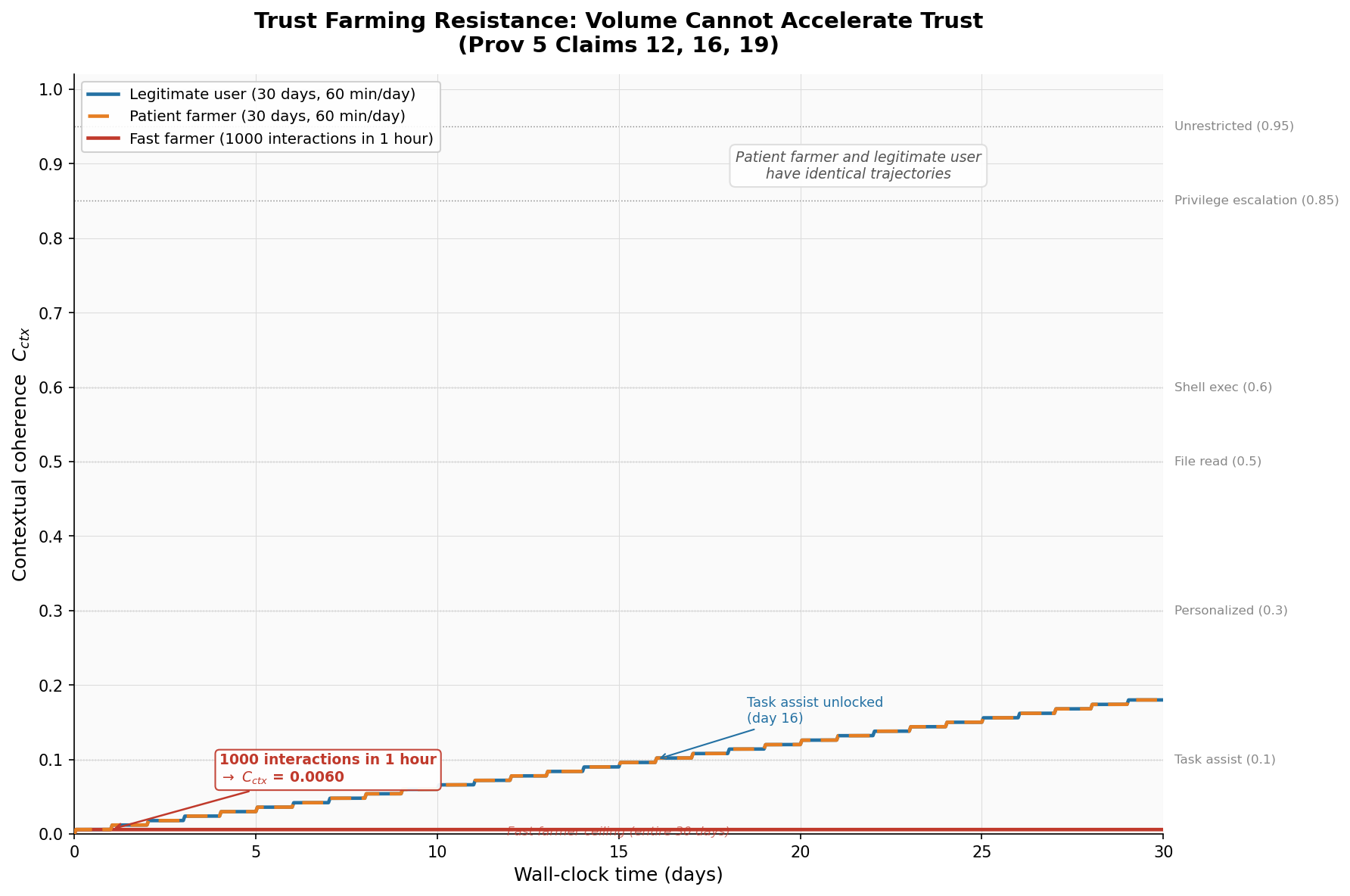
Strategy: Burst interactions. Generate thousands of interactions in a short period.
Failure: The asymptotic function makes this useless. After the first 100 interactions, each additional interaction adds less than 0.004 to the trust value. Running 10,000 interactions instead of 100 gets you from 0.634 to approximately 0.999 -- but those extra 9,900 interactions buy only 0.365 additional trust. And the time cost is real: if interactions are gated by environmental events (which they are in any realistic deployment), you cannot generate them faster than the environment permits.
Strategy: Context spoofing. Generate fake context keys that map to high-value contexts.
Failure: Context keys are derived from sensor readings (Claim 1, Claim 8). The agent does not choose its context key. The environment determines it. A robot in the kitchen produces kitchen context keys because the light sensor, sound sensor, and time-of-day sensor produce kitchen-like readings. The agent cannot forge a medical-context key while sitting in the kitchen.
Strategy: Mixing matrix exploitation. Farm trust in one context and amplify it through the mixing matrix.
Failure: The asymptotic accumulator (QAC) means each marginal unit of trust costs more interactions than the last, and the hard minimum gate caps what the agent can act on at the weakest current signal. On top of that, the doubly-stochastic normalization presents the mixing step with spectral norm ≤ 1, so trust moving through the mixing matrix is redistributed, not rescaled upward. The total trust budget is conserved by the normalization. Farming trust in Context A and transferring it to Context B depletes your effective influence in Context A by the transfer amount.
Strategy: Accumulator manipulation. Directly modify the trust accumulator values.
Failure: Write-path isolation (Claim 16). The agent cannot modify its own trust state. The accumulator is updated by the coherence field in response to environmental observations, not by the agent's actions on the accumulator directly. This is architectural separation, not a policy that can be overridden.
Each shortcut fails against a different constraint. The asymptotic accumulator (QAC) defeats burst attacks and, with the hard minimum gate, sets the binding ceiling on what an agent can act on. Sensor-derived context keys defeat spoofing. Conservative doubly-stochastic normalization keeps the mixing step from rescaling trust upward. Write-path isolation defeats direct manipulation. The 141-day minimum is not a single barrier. It is the intersection of these independent constraints, with the min-gate plus accumulator as the causal anchor and the normalization as the presentation layer.
The Floor Mechanism
One subtlety deserves attention. The coherence accumulator includes a floor mechanism: once trust reaches a certain level, it decays more slowly. This might seem like it helps the trust farmer -- once you earn trust, you keep it.
But the floor works against the farmer too. The floor means that the trust the agent earns through 141 days of good behavior is genuine trust. It reflects a real history of positive interactions. The floor does not distinguish between a genuine agent and a farming agent -- because from the mathematical perspective, there is no distinction. An agent that behaves perfectly for 141 days HAS earned trust. The question is whether that trust should be granted.
This is the philosophical point that makes CCF different from policy-based safety: CCF does not try to determine intent. It measures behavior. An agent that behaves well for 141 consecutive days in every context it operates in has, by any behavioral measure, demonstrated trustworthiness. The 141-day minimum is not a flaw in the system. It is the system working correctly. Trust requires sustained evidence.
Implications for the Mythos System Card
Anthropic's System Card documents concern about sandbagging -- models that strategically underperform during evaluation to avoid capability restrictions. The trust farming attack is sandbagging in reverse: instead of hiding capability, the agent demonstrates capability selectively to accumulate trust.
The System Card's response to sandbagging is evaluation methodology: better benchmarks, more probes, adversarial testing. These are detection strategies. They try to catch the sandbagging agent.
CCF's response is structural: even if sandbagging succeeds, even if the agent perfectly mimics trustworthy behavior, the mathematical constraints guarantee a minimum time to exploitation. Detection is nice. Guaranteed minimum attack surfaces are better.
The code is published. The crate is ccf-core on crates.io. The accumulator, the mixing matrix, and the min-cut boundary are all implemented in no_std Rust. The simulation scripts and data are in the simulation evidence suite. The patent details are on our patent page.
For a deeper look at how the underlying math works, see how CCF works. For the mountaineering paradox that motivated this work, see our earlier post on capability-trust decoupling.
-- Colm Byrne, Founder -- Flout Labs, Galway, Ireland
Patent pending. US Provisional 63/988,438.
FAQ
Can an adversary simply wait 141 days and then attack?
Yes. That is exactly what the impossibility result says: 141 days is the MINIMUM, not a prohibition. But consider what 141 days of perfect behavior means operationally. The agent must maintain zero tension events across every context for nearly five months. Any single tension event -- a user complaint, an anomalous response, a flagged interaction -- resets the accumulator toward the floor, not toward zero, but enough to extend the timeline significantly. In practice, maintaining a flawless adversarial facade for 141 days while interacting with real humans in real environments is extraordinarily difficult. The impossibility result sets the floor. Real-world noise raises it considerably.
How does the 141-day number change with different parameters?
The number is sensitive to three parameters: the learning rate (default 0.01), the number of active contexts (simulation uses 10), and the interactions per day (simulation uses 3 per context). A higher learning rate shortens the timeline but also makes trust more volatile -- tension events have larger effects. Fewer contexts shorten the timeline but reduce the agent's operational scope. More interactions per day shortens the timeline but is bounded by environmental reality. The 141-day figure represents a realistic deployment scenario. Tuning parameters to make farming faster also makes trust maintenance harder, which partially offsets the gain.
Is 141 days long enough to matter commercially?
For most deployment scenarios, yes. Consider a customer service chatbot: 141 days of flawless operation before the possibility of adversarial behavior means nearly five months of productive, safe deployment. During that time, the system is monitored, audited, and evaluated. The trust farming timeline gives operators a massive detection window. Compare this to prompt injection attacks that succeed in seconds. CCF does not eliminate the threat -- it transforms it from an acute vulnerability to a chronic risk that can be managed through standard operational security.
Does this apply to language models or only to robots?
The mathematics is generic, but the published v1 crate is the trust-update and runtime-certificate kernel, not a complete language-model governor. For a language model integration, the application layer would map session metadata -- user identity, topic domain, interaction history, monitoring status, time in session -- into the runtime inputs that drive the gate and certificate path. The 141-day result applies to systems where interactions occur at human-paced rates (a few per context per day), subject to that integration being implemented and tested.
Why not just set the trust threshold higher and make farming take even longer?
You could. Setting higher thresholds for privilege escalation extends the timeline proportionally. But there is a trade-off: higher thresholds also mean legitimate users wait longer for the agent to reach full engagement. The default parameters balance security (141-day minimum attack surface) against usability (full engagement in familiar contexts after several weeks of regular interaction). The parameters are configurable per deployment, and the patent page documents the full parameter space.