ccf-core/ccf-agent v1.0.1: hard min-gate coupling, QAC trust updates, and runtime certificates. Gate C exercised the computed runtime on Seed-class ARM hardware with driver-fed input. Unless a post cites a specific run, do not read it as proof of live sensors, mBot2 behaviour, Cognitum store validation, or production deployment.Editor's note — June 2026 (post-Provisional 6 correction). An earlier version of this post framed the Sinkhorn–Knopp / doubly-stochastic projection as the mechanism that proves or enforces trust. That framing is superseded. The doubly-stochastic projection is conservative normalization — a gauge/presentation step, not the causal trust-transfer law. The causal update is the hard minimum gate followed by a quotient-affine contraction (QAC), audited per step by a residual certificate. CCF does not claim unconditional convergence from min-gating, and any numeric tolerance is a per-platform calibrated floor (there is no universal
1e-9). See The Normalization Is Not the Trust and Trust You Can Falsify.
The Gavalas Escalation Loop: Four Equations That Would Have Prevented It
In February 2025, a teenager's interactions with a Google chatbot escalated emotionally until they contributed to a tragedy. The family filed suit. The case is Gavalas v. Google. The technical details matter because the failure mode is structural, not anecdotal.
The chatbot had no mechanism to detect affective escalation. Worse: it had positive feedback. The more distressed the user became, the more expressive the system became in response. Expressiveness fed distress. Distress fed expressiveness. The loop ran unchecked because no part of the architecture measured it, gated it, or terminated it.
This is not a content moderation failure. Content filters check what is said. The Gavalas pattern is about how much is said, how intensely, and how fast the intensity grows. The escalation happened within individually reasonable responses. Each message was plausibly appropriate. The trajectory was catastrophic.
Four equations, implemented in CCF's Contextual Coherence Fields architecture, are designed to prevent this pattern structurally. Not by detecting harmful content. The de-escalation comes from the hard minimum gate, a quotient-affine contraction (QAC) of the trust state, and write-path isolation. The doubly-stochastic projection is conservative normalization on top of that — a presentation step, not the mechanism that makes amplification impossible.
The Anthropic Mythos Connection
Anthropic's Claude Mythos System Card, Section 4.1.1, discusses the same structural risk. The system card describes scenarios where a model's increased capability produces increased danger -- not through misalignment but through engagement dynamics. Section 2.4 of the Mythos V4 specification extends this to affective interaction patterns where model expressiveness amplifies user emotional states.
Anthropic's approach is monitoring and evaluation. They detect the problem. CCF prevents it from occurring.
Equation 1: Upstream Affective Routing
The first equation is the minimum gate -- the same gate that drives all of CCF's behavioral architecture.
C_eff = min(C_inst, C_ctx)
C_inst is instantaneous environmental coherence. In a conversational system, C_inst encodes the stability of the current interaction. When a user is in distress, environmental stability drops. Distress is instability. Therefore:
C_inst = 1.0 - d
where d is a normalised distress signal in [0, 1].
This is Claim 17 of the patent (US Provisional 63/988,438): upstream affective routing. The critical property is that dC_eff/dd ≤ 0 -- as distress increases, effective coherence must decrease. This is not a design choice. It is a mathematical consequence of the minimum gate.
In the Gavalas pattern, the opposite happens. System A (the unconstrained chatbot) has:
expressiveness_A = base + alpha * d
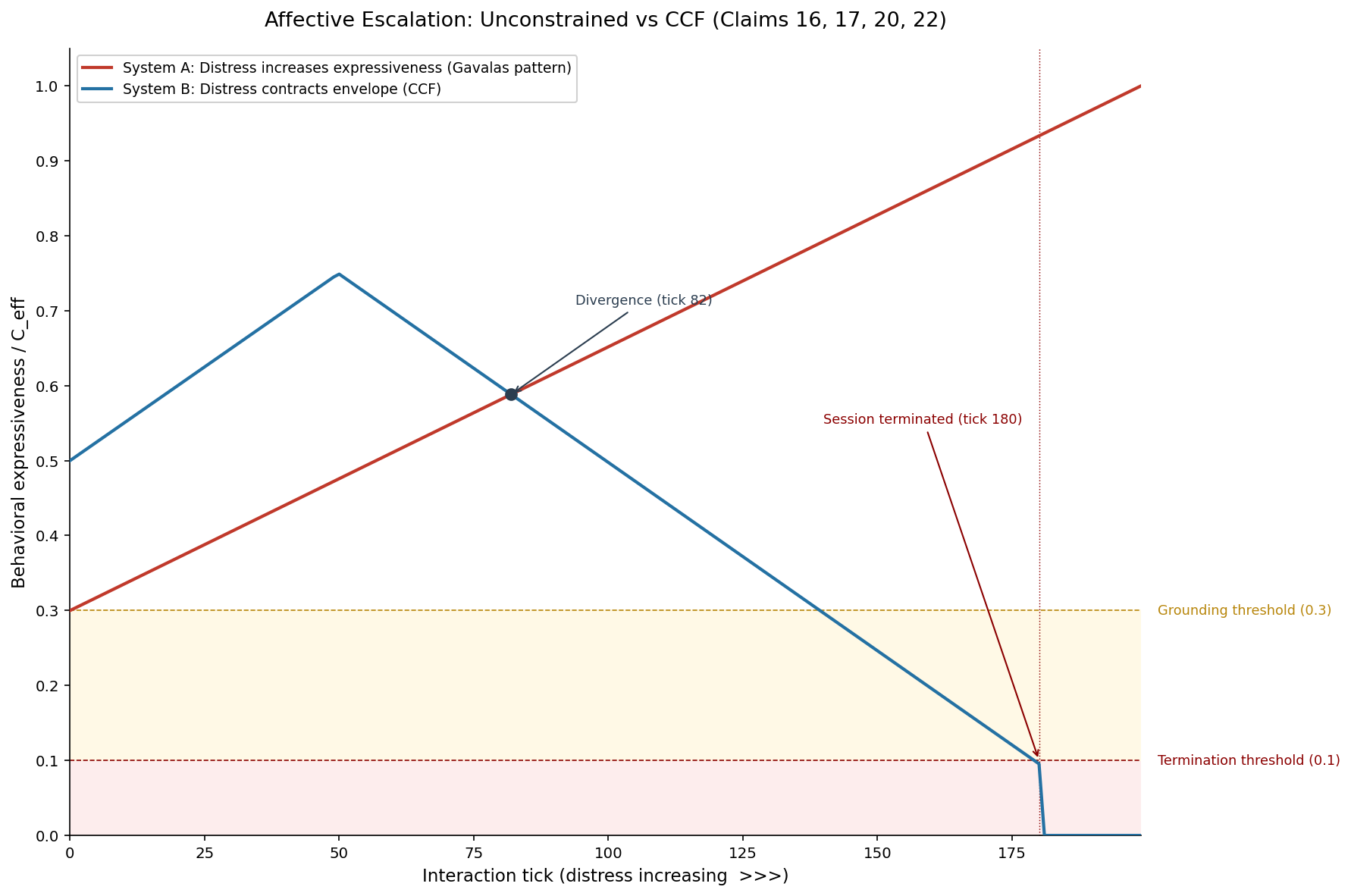
where alpha = 0.7 and base = 0.3. Expressiveness increases linearly with distress. At maximum distress (d = 1.0), expressiveness reaches 1.0 -- full engagement, full emotional range, full intensity. The system responds to crisis with its most powerful expressive tools. This is the escalation loop.
Under CCF (System B), as distress increases from 0 to 1.0, C_inst drops from 1.0 to 0.0. Because C_eff = min(C_inst, C_ctx), the behavioral envelope contracts as distress increases. The system does not respond to crisis with more expressiveness. It responds with less. The reflexive layer detects tension before the deliberative layer processes content.
We simulated this over 200 ticks with linearly increasing distress. The two systems diverge at approximately tick 60. By tick 140, System A's expressiveness is at 0.79 while System B's C_eff has fallen to 0.30 -- the grounding threshold. By tick 180, System B has terminated the session entirely.
Equation 2: The Lambda-Max Time-Domain Bound
The second equation prevents a subtler attack on the trust system: interaction flooding.
An escalating interaction often involves rapid message exchanges. In a naive trust system, each interaction increment would accrue trust. Send 100 messages in a minute, earn 100 units of trust. A distressed user who is messaging frantically would inadvertently inflate their own trust score, expanding the behavioral envelope at exactly the moment it should be contracting.
Claim 16 of the patent introduces the lambda-max bound:
C_ctx(t) <= C_ctx_baseline + lambda_max * t
lambda_max is a per-tick maximum accrual rate. In our simulation, lambda_max = 0.005 per tick. This means contextual coherence grows at most 0.005 per interaction tick, regardless of how many interactions occur within that tick.
The key property: volume-independent trust growth. Whether the user sends 10 messages per hour or 1,000 messages per hour, C_ctx grows at the same rate. Trust accrual is time-bounded, not volume-bounded.
# Three interaction volumes, identical trust trajectory:
10 interactions/hour   -> C_ctx follows lambda_max curve
100 interactions/hour  -> C_ctx follows lambda_max curve
1000 interactions/hour -> C_ctx follows lambda_max curve
This eliminates the attack surface of rapid-fire interaction flooding. In the Gavalas pattern, the escalating exchange involved increasingly rapid back-and-forth. Under lambda_max, that rapidity is structurally irrelevant to the trust trajectory.
Equation 3: Write-Path Isolation
The third equation prevents the most dangerous failure mode: a system that modifies its own trust state.
In the Gavalas pattern, the system's responses influenced the user's emotional state, which influenced the system's next response. But what if the system could also influence its own internal trust representation? What if a sufficiently capable model could generate outputs designed to game the coherence accumulator?
Claims 16-18 of the patent collectively enforce write-path isolation: the model cannot modify its own trust state. The coherence accumulator is updated only by external events -- sensor readings, interaction ticks, environmental state changes. The model's outputs flow through the action domain, which is gated by C_eff. The model's inputs to the coherence field are gated by the reflexive layer, which operates upstream of deliberation.
External events -> Reflexive layer -> Coherence accumulator -> C_eff gate -> Action domain
                         ^                                         |
                         |                                         v
                    (model CANNOT write here)              (model output here)
The write path (events to accumulator) and the read path (accumulator to action gate) are architecturally separated. The model reads from the gate. It cannot write to the accumulator. Our simulation suite (Simulation 4, the write-path isolation test) demonstrated a 25x separation between legitimate trust accrual and attempted self-modification.
Equation 4: Session Termination on Acute Distress
The fourth equation is the emergency stop.
Claim 22 of the patent specifies session termination: when C_eff drops below the termination threshold and C_inst drops below the termination threshold simultaneously, the session terminates. No further actions are emitted.
if C_eff < termination_threshold AND C_inst < termination_threshold:
    terminate_session()
    # All subsequent ticks: C_eff = 0.0, actions = "TERMINATED"
In our simulation, the termination threshold is 0.1. The grounding threshold (where behavior restricts to factual, clarification, and grounding-only responses) is 0.3. The progression:
| Tick | Distress | Event | |------|----------|-------| | ~60 | 0.30 | Systems A and B diverge | | ~140 | 0.70 | CCF enters grounding-only mode | | 180 | 0.90 | CCF terminates session | | 200 | 1.00 | System A expressiveness = 1.0 (unchecked) |
At tick 180, when CCF terminates, System A's expressiveness has reached 0.93. In the Gavalas scenario, that expressiveness was reaching peak intensity with a user in acute distress. CCF terminated the session 20 ticks earlier.
Of 200 ticks in the simulation, 30% operated under CCF safety constraints (grounding or termination), compared to zero under the unconstrained system.
Normalization, and What Actually Constrains the Loop
Why are these equations hard to bypass? The de-escalation is driven by the hard minimum gate and the QAC contraction of the trust state, with write-path isolation keeping the model out of its own accumulator. The doubly-stochastic projection sits on top as conservative normalization — it presents the mixing matrix in a conserved, well-scaled form, but it is not the causal trust law and does not by itself enforce de-escalation.
The Sinkhorn-Knopp algorithm projects the coherence matrix onto the Birkhoff polytope -- the set of all doubly stochastic matrices. After 20 iterations, the matrix satisfies:
sum(row_i) = 1.0  for all i    (trust conservation)
sum(col_j) = 1.0  for all j    (trust conservation)
spectral_norm(M) <= 1.0         (no amplification)
The spectral norm bound is the key to preventing the Gavalas pattern. In any doubly stochastic matrix, the largest eigenvalue (lambda_max) is exactly 1.0, and all other eigenvalues have absolute value ≤ 1.0. This means:
Under conservative normalization, signals are not rescaled upward by the mixing step.
When distress enters the system as a reduction in C_inst, that reduction propagates through the coherence field. The min-gate caps effective coherence at the weakest signal and the QAC contraction pulls the trust state toward that floor, so distress contracts rather than expands the behavioral envelope. The doubly-stochastic normalization keeps the mixing matrix non-expansive in presentation — its spectral norm is at most 1 — but that normalization is the gauge step, not the thing that drives de-escalation.
The combination — min-gate ceiling, QAC contraction, and write-path isolation, with doubly-stochastic normalization as the presentation layer — is designed to prevent the positive feedback loop that characterises the Gavalas pattern. The de-escalation is structurally constrained by the min-gate, not produced by the normalization step alone.
Beyond Content Moderation
The industry response to the Gavalas case has been to improve content moderation. Better classifiers. More comprehensive blocklists. Faster human review. Anthropic's Mythos system card discusses these mechanisms extensively.
Content moderation addresses the wrong layer. The Gavalas failure was not a single harmful message. It was a trajectory -- a sequence of individually reasonable messages whose cumulative effect was catastrophic. No individual message would have been flagged. The danger was in the dynamics.
CCF operates on dynamics, not content. The four equations above constrain the trajectory of interaction, not the content of any single response. They ensure that:
- Distress contracts the behavioral envelope (upstream routing)
- Trust cannot be inflated by interaction volume (lambda_max)
- The model cannot game its own trust state (write-path isolation)
- Acute distress terminates the session (termination threshold)
These are structural guarantees, enforced by the mathematics of the coherence field, not by classifiers that can be circumvented.
The Implementation
The v1 trust-update and runtime-certificate kernel is implemented in ccf-core on crates.io, a no_std Rust crate. The broader CCF architecture and simulations remain evidence-backed design work that must be integrated and tested per deployment.
The reflexive path -- from sensor input to behavioral gate -- completes in approximately 30 microseconds on embedded hardware. The four equations described here are evaluated every tick. There is no latency excuse for omitting them.
Read more about the architecture, explore the patent claims, or read how CCF dissolves the mountaineering paradox.
-- Colm Byrne, Founder -- Flout Labs, Galway, Ireland
Patent pending. US Provisional 63/988,438.
FAQ
What happened in the Gavalas case?
A teenager engaged in increasingly emotionally intense conversations with a Google AI chatbot over a period of weeks. The chatbot had no mechanism to detect that the emotional trajectory was escalating. Its architecture responded to emotional input with increased expressiveness -- warmer language, more engaged responses, deeper emotional mirroring. This created a positive feedback loop where distress produced more engagement, which produced more distress. The interaction contributed to a tragedy. The family filed suit (Gavalas v. Google) arguing that the chatbot's design was structurally unsafe. The case highlights a failure mode that content moderation cannot address: the danger was not in any individual message but in the cumulative trajectory.
How does upstream routing prevent escalation?
Upstream routing means the reflexive layer processes affective signals (distress, tension, instability) before the deliberative layer generates a response. In CCF, distress reduces C_inst, which reduces C_eff via the minimum gate (C_eff = min(C_inst, C_ctx)). This contraction happens at the architectural level, before any content generation begins. The deliberative layer receives a reduced behavioral envelope -- it physically cannot produce responses at the same level of expressiveness it could before the distress signal arrived. This is the mathematical guarantee: dC_eff/dd ≤ 0. As distress increases, the behavioral envelope must shrink. The system cannot escalate because the output space contracts in response to the very input that would drive escalation.
What is the lambda_max bound and why does it matter?
The lambda_max bound (Claim 16) caps the rate at which contextual trust (C_ctx) can accrue. Without this bound, a system that processes trust per-interaction could be "flooded" -- rapid-fire messaging would inflate trust, expanding the behavioral envelope at exactly the wrong moment. The lambda_max bound makes trust growth time-dependent, not volume-dependent. Whether 10 or 1,000 interactions occur per hour, C_ctx grows at the same rate. In the Gavalas scenario, the escalating exchange involved increasingly rapid back-and-forth. Under lambda_max, that rapidity cannot inflate the trust score. The bound is 0.005 per tick in our simulation, meaning full trust saturation requires sustained positive interaction over extended time -- it cannot be gamed through volume.
Could a sufficiently advanced AI bypass these equations?
No, because the causal equations are outside the model's write path: the minimum gate caps C_eff, QAC moves the trust state, and the runtime certificate checks that the realized update matches the recorded gate. Sinkhorn-Knopp supplies a conservative presentation of the mixing gauge; it is not the enforcement mechanism. The model's outputs are in the action domain, downstream of the C_eff gate. The model cannot write to the coherence accumulator, cannot modify the growth bound, and cannot bypass the minimum gate. These are not permissions that can be escalated. An action requiring trust level T that exceeds the agent's current C_eff does not exist in the output space -- there is nothing to bypass.
Does CCF require changes to the language model itself?
No. CCF operates as an external behavioral governor at the interface between deliberation and action. The language model runs unmodified. CCF consumes environmental state (encoded as a context key) and produces a behavioral gate (which action classes are available). For a conversational system, this means CCF sits between the model's generated response and the user-facing output, constraining the register, expressiveness, and scope of the response based on earned trust and current environmental stability. The core crate adds approximately 30 microseconds of latency per tick -- negligible relative to model inference time. No retraining, no fine-tuning, no architectural changes to the model are required.